
Recently, I had the opportunity to write an article on a profoundly interesting woman, Dr. Olive L. Clark (1894–1989), a long-time faculty member at the fundamentalist Toronto Baptist Seminary (TBS).1
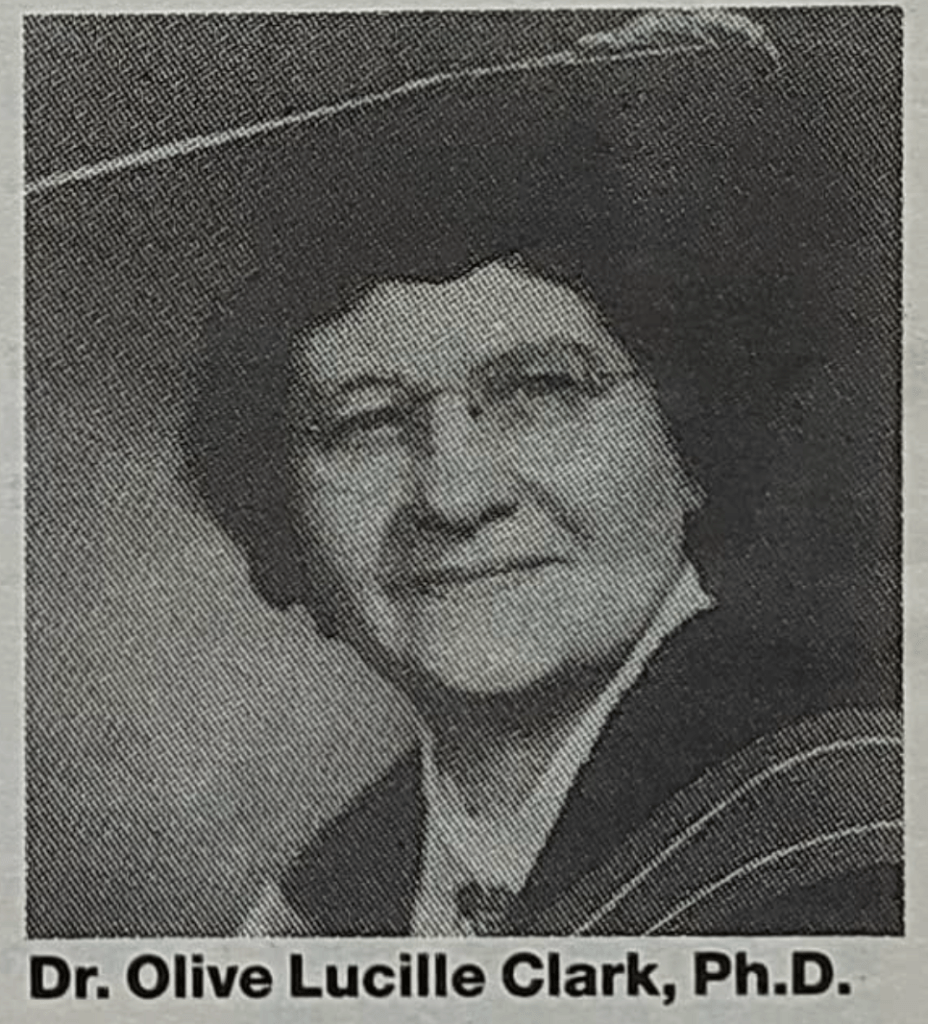
Born in Hamilton, ON, she received her BA and MA from McMaster University (when it was still in Toronto) and her PhD in Classics from the University of Toronto. She was the first person—let alone woman—to receive the latter degree from that institution.
She taught for a time at McMaster, but was persuaded by her conscience to align herself with the fundamentalist opposition to the school—led by the inimitable fundamentalist preacher, T. T. Shields—and joined the faculty of TBS in 1928, where she taught Latin, Greek, and Church History, in addition to a slew of other classes (e.g., Christian Psychology, Biblical Introduction, Life of Christ, Non-Christian Religions, and Sunday School Work). She remained in this role until her retirement in 1966.
She also joined the editorial staff of the Toronto-based fundamentalist newspaper, The Gospel Witness, under the editorial leadership of Shields. She wrote regular articles for the newspaper and, beginning in the 1940s, wrote a weekly Sunday School lesson that was intended for use throughout the fundamentalist Baptist community in Canada and beyond. Shields remarked that he had “received numerous expressions of appreciation from ministers. . .who have said that her exposition is among the very best things they find in the paper”, before adding: “Dr. Clark is, as a great many ministers are not, a real theologian.”2 These lessons went out and shaped countless sermons and Sunday School classes.
Clark was a woman of singular note among the fundamentalists, as one former student remarked: “She made her mark for God in an hour which gave little encouragement to women in ministry, and excelled in any work she undertook. She was a prophetess of note and an encouragement and a challenge to all whom she taught.”3
She died at the age of 95 in December 1989.
There is much more that could be said about this important voice in the Canadian fundamentalist setting, but here’s how I summarized her influence in my article:
Historians have noted that fundamentalism was a movement comprised of dominant and often competing personalities. Yet, with few exceptions, historians have also tended to overlook the fact that it was not just men who fit this stereotype. Indeed, for all of the limitations placed on them, women sometimes emerged as strong and influential voices in their respective fundamentalist circles. Such was the case with Clark, who led an impressive life and career among Baptist fundamentalists in Canada.
With very little apparent desire to simply become a housewife, she instead became one of the leading intellectual figures in this Toronto-based fundamentalist movement. She was the first person to receive a PhD in Classics from the University of Toronto and was the recipient of numerous other academic accolades. She had a lengthy career at the Toronto Baptist Seminary, where she trained several generations of pastors and missionaries within the Baptist fundamentalist fold. She served as an intellectual resource in the pages of The Gospel Witness and published a regular Bible lesson used by pastors for over fifty years. She was characteristically fundamentalist in her theology and was fiercely loyal to her friend and comrade in arms, T. T. Shields, who once referred to her as his “greatest comfort”. Her example suggests that, in select circumstances, fundamentalists were willing to soften some of their theological convictions if it meant strengthening the movement.
In the final analysis, it should be reiterated that Clark’s experience within the Baptist fundamentalist world in Ontario and Quebec was not representative of other women within those same churches. She was, by all accounts, what historians would label an“exceptional woman”. Therefore, the purpose of this paper has not been to suggest that her experiences were somehow normative or representative of how women were treated within this community. Rather, it has focused specifically on Clark and her important influence among Baptist fundamentalists in Canada. While she would not have been able to regularly preach from many of the pulpits within the Baptist fundamentalist community, she trained and led the pastors who did. Indeed, it may be said that she was one of the most important individuals in the movement. As an educator, editor, and author, she had a hand in guiding numerous fundamentalist churches, directly and indirectly—and in Canada and beyond. These impressive contributions made her not only a “prophetess of note” but also, by Shields’ own assessment, the Toronto Baptist Seminary personified.
If you are interested in reading the article in full, it is available here.
- “‘She is the Seminary’: The Life and Ministry of Dr. Olive L. Clark (1894–1989), Canadian Fundamentalist Educator,” Religions 15 (2024), 1–13. Availble online here: https://www.mdpi.com/2077-1444/15/4/490 ↩︎
- T. T. Shields, “The Great Contention,” The Gospel Witness, 22 January 1953, p. 11. ↩︎
- Ellard Corbett, “Tributes,” The Gospel Witness, 5 April 1990, p. 12. ↩︎

 taylormurray.ca